
NIST Cybersecurity – Training Courses
What is NIST Cybersecurity?
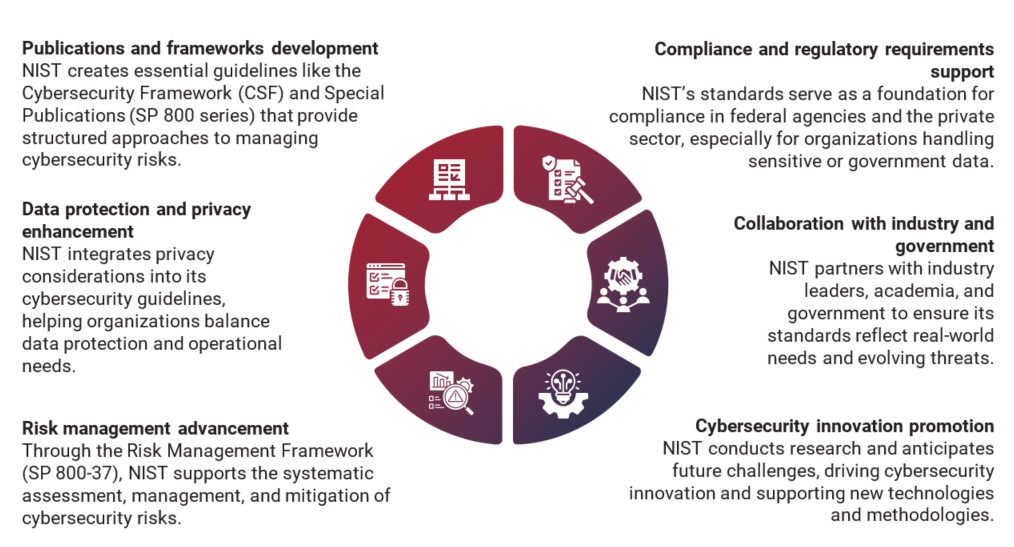
The National Institute of Standards and Technology (NIST) shapes the cybersecurity landscape by developing special publications, frameworks, guidelines, best practices, and resources. These resources support federal agencies and other organizations in implementing effective cybersecurity measures. NIST’s initiatives range from practical, immediate guidance for organizations to forward-looking research addressing technological advancements and emerging security challenges.
In addition to cybersecurity, NIST works to improve privacy risk management, recognizing the strong link between privacy and cybersecurity. A core NIST function is developing best practices that both private organizations and government agencies can adopt to strengthen their security postures, particularly when handling government data.
One of NIST’s major contributions is the Cybersecurity Framework (CSF), which helps organizations manage and reduce security risks in a consistent and proactive manner. NIST also offers a comprehensive range of Special Publications (SP) addressing specific areas of cybersecurity.
- NIST SP 800-12 provides an overview of essential information security principles to help organizations secure their systems and data.
- NIST SP 800-53 offers detailed guidelines on security and privacy controls, primarily for federal information systems, though it is widely used across sectors.
- NIST SP 800-37 gives a framework for information systems and organizations on how to assess, manage, and monitor risks.
- NIST SP 800-171 addresses the protection of Controlled Unclassified Information in nonfederal systems and is essential for organizations that work with federal agencies.
Why is NIST Cybersecurity important for you?
The NIST Cybersecurity Framework is an essential resource for anyone building a career in cybersecurity. It offers a structured approach to risk management, guiding you to effectively assess, protect, detect, respond to, and recover from cyberattacks. Mastery of this framework provides a competitive advantage, allowing you to confidently navigate the complex cybersecurity landscape and contribute to building more resilient and secure digital environments for any organization.
Benefits of NIST Cybersecurity Certification
NIST Cybersecurity certificate will prove that you have:
- A solid understanding of NIST publications and core cybersecurity principles and concepts
- The necessary knowledge to design, implement, and maintain an effective cybersecurity program tailored to the needs of an organization
- Skills to effectively assess, analyze, and respond to cyber threats
- Proficiency in protecting an organization’s data and systems against cyber threats
- The capability to support an organization in continually improving its cybersecurity program
- Knowledge and skills to monitor and manage security controls in line with NIST guidelines and best practices
NIST Cybersecurity Consultant Course
The Certified NIST Cybersecurity Consultant training course equips participants with the essential knowledge and skills required for cybersecurity compliance and resilience, based on NIST publications. It covers key NIST publications, including NIST SP 800-12 for information security fundamentals and best practices and NIST SP 800-53 for implementing security and privacy controls for information systems and organizations.
This training course also covers the NIST risk management framework, guiding participants through the strategic management of cybersecurity risks. Additionally, participants can learn about NIST SP 800-171, focusing on protecting Controlled Unclassified Information in nonfederal systems and organizations.
The course introduces the NIST Cybersecurity Framework’s core functions—Identify, Protect, Detect, Respond, and Recover— to effectively enhance an organization’s cybersecurity posture.
Why should you attend?
In today’s increasingly digital world, organizations face growing challenges in securing their information systems and ensuring compliance with regulatory standards. NIST publications such as NIST SP 800-12, NIST SP 800-53, NIST RMF, NIST SP 800-171, and the NIST Cybersecurity Framework offer comprehensive guidelines and best practices for establishing robust cybersecurity measures. Implementing these frameworks helps organizations enhance their cybersecurity posture, manage risks effectively, and maintain compliance with federal requirements.
Through in-depth guidance on NIST publications, participants learn to tackle complex security challenges, applying frameworks to build robust cybersecurity programs that align with organizational goals. The course also provides practical expertise to prevent, detect, and respond to cyber threats efficiently, integrating best practices and standards to create a cohesive security approach.
Upon completing the course, participants will be eligible to take the exam. Those who pass the exam will be awarded the globally recognized “PECB Certified NIST Cybersecurity Consultant” credential.
Who should attend?
This training course is intended for:
- Executives or directors responsible for overseeing cybersecurity initiatives within their organizations
- System administrators and network engineers seeking a deeper understanding of security controls and risk management processes to adhere to NIST security standards
- Professionals involved in the development and implementation of cybersecurity programs
- Consultants and advisors who provide cybersecurity and compliance services, ensuring they stay up to date with the latest NIST frameworks and best practices
- Digital forensics and cybercrime investigators who need to understand the technical and regulatory aspects of cybersecurity frameworks to investigate and respond to security incidents comprehensively
- Individuals working in cybersecurity or information security who aim to enhance their understanding of NIST guidelines and develop practical skills in managing cybersecurity risks
Learning objectives
Upon completion of this training course, participants will be able to:
- Discuss fundamental cybersecurity principles and concepts, including confidentiality, integrity, and availability, and how these principles are applied to protect information systems
- Explain key NIST publications, including NIST SP 800-12, NIST SP 800-53, the Risk Management Framework, NIST SP 800-171, and the NIST Cybersecurity Framework, and apply their guidance and requirements
- Implement a process to effectively monitor, assess, and manage security controls based on NIST publications
- Apply structured risk management techniques to identify, assess, and prioritize cybersecurity risks
- Develop risk mitigation strategies and implement risk treatment plans that align with NIST’s risk management recommendations, ensuring a balanced approach to risk reduction and resource allocation
- Design a cybersecurity program that aligns with the organization’s strategic goals and addresses specific security requirements
Educational approach
This training course:
- Integrates theoretical knowledge of NIST publication, including NIST SP 800-12, NIST SP 800-53, NIST RMF, NIST SP 800-171, and the NIST Cybersecurity Framework, alongside best practices in cybersecurity and risk management
- Covers the application of risk management processes outlined in the NIST Risk Management Framework, providing techniques for effective risk assessment and mitigation
- Emphasizes the development of a comprehensive System Security Plan to document cybersecurity requirements
- Guides participants on utilizing the NIST Cybersecurity Framework to build and maintain a cybersecurity program
- Facilitates thorough preparation for certification through scenario-based quizzes that simulate the format and complexity of certification exams
- Prepares participants to manage contingencies and disasters by implementing comprehensive strategies that ensure the continuity of organizational operations
Prerequisites
The main requirement for participating in this training course is having a fundamental understanding of cybersecurity principles and frameworks.
Additional Information
- Training Days: 5
- CPD Certification (Credits): 31
- Exam Duration : 3 hours
- Retake Exam: Yes